
This is general information, not legal advice.
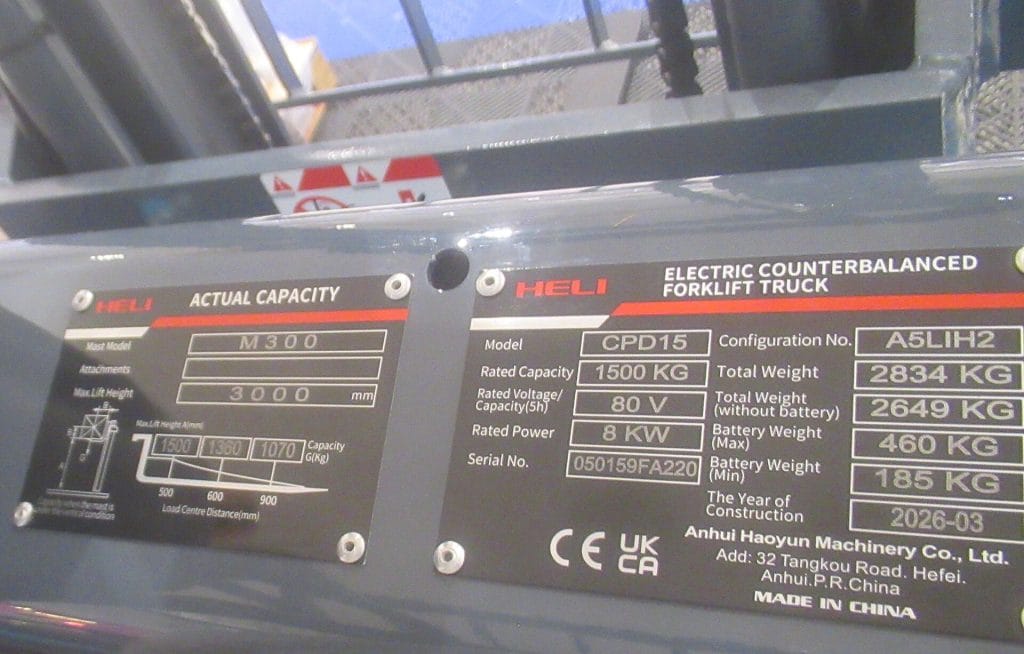
Every forklift has a data plate. It is usually a small metal plate near the operator’s seat or on the dash. Most operators glance at it once and never look again. That is a mistake. The data plate tells you how much the truck can safely lift, and under what conditions. If you don’t understand it, you can overload the truck without knowing it.
What is on a forklift data plate?
Layouts vary by manufacturer, but most plates show:
- The truck model and serial number
- The truck’s own weight
- The type designation, which relates to where the truck may safely be used
- The rated capacity, given at a stated load centre
- Any attachment the truck has been rated with
The US Occupational Safety and Health Administration (OSHA) has a clear guide to reading a forklift nameplate. It also gives a simple rule worth repeating: don’t operate a truck with a missing or unreadable plate.
Capacity always comes with a load centre
The capacity number on the plate is not a stand-alone figure. It only applies when the load sits at the load centre shown beside it.
The load centre is the horizontal distance from the vertical face of the forks (or attachment) to the load’s centre of gravity. On many North American trucks the standard is about 610 mm (24 inches). That figure is based on an evenly weighted load centred on a 1,220 mm by 1,220 mm (48 by 48 inch) pallet, as OSHA explains in its load handling guide.
Think of the front wheels as the pivot point of a teeter-totter. The counterweight sits on one side and the load sits on the other. The farther the load’s weight is from the front wheels, the more leverage it has to tip the truck forward.
When the load centre moves, capacity drops
Real loads are not always neat, centred pallets. Long, wide or unevenly weighted loads push the centre of gravity farther out. When that happens, the truck can safely lift less than the plate number.
OSHA offers a rough guideline for estimating the reduced capacity: multiply the rated capacity by the rated load centre, then divide by the actual load centre. For example:
- Rated capacity: 1,500 kg at a 600 mm load centre
- Actual load centre: 750 mm
- Estimate: 1,500 × 600 ÷ 750 = about 1,200 kg
Treat this as an estimate only. The manufacturer is the authority on your truck. If you regularly handle long or odd-shaped loads, ask the dealer or manufacturer for a capacity chart for those conditions.
Lift height and attachments matter too
The Canadian Centre for Occupational Health and Safety (CCOHS) notes in its forklift load handling guide that the load limit is shown on the data plate, and that a lift truck is less stable when the load is raised. Some plates list a lower capacity at greater heights. Check your plate before stacking high.
Attachments also change the numbers. A sideshifter, clamp or fork extension adds weight and can move the load farther from the front wheels. OSHA notes that adding an attachment generally lowers capacity. If an attachment is added or changed, the plate should reflect it. If it doesn’t, stop and talk to your supervisor before using the truck.
Habits that keep you inside the limits
- Read the data plate during your pre-use inspection, especially on an unfamiliar truck.
- Know the weight of the load. Check the shipping paperwork or labels, and don’t guess.
- Keep the load tight against the backrest and close to the front wheels.
- Put the heavier end of an uneven load toward the front wheels, as CCOHS advises.
- Never add extra weight to the back of the truck to “balance” an overload.
- If the plate is missing, damaged or doesn’t match the attachment, tag the truck out and report it.
What employers should check
Supervisors should make sure every truck has a legible, accurate plate and that operators are trained to read it. Follow the manufacturer’s specifications and the rules in your province. In Alberta, the requirements for forklifts and other powered mobile equipment are in Part 19 of the OHS Code. It also helps to keep a clear record of who was trained on which truck. Our post on what makes a good operator training record covers what to include.
The same idea applies to other machines. Skid-steers have their own capacity rules, explained in tipping load vs rated operating capacity.
Learn to read the plate with confidence
Our Forklift Operator Training Online: CSA B335 Theory course covers reading the data plate, load centres and capacity, with a hands-on capacity calculator. It also includes a practical evaluation checklist your qualified trainer completes on your own trucks.