
This is general information, not legal advice.
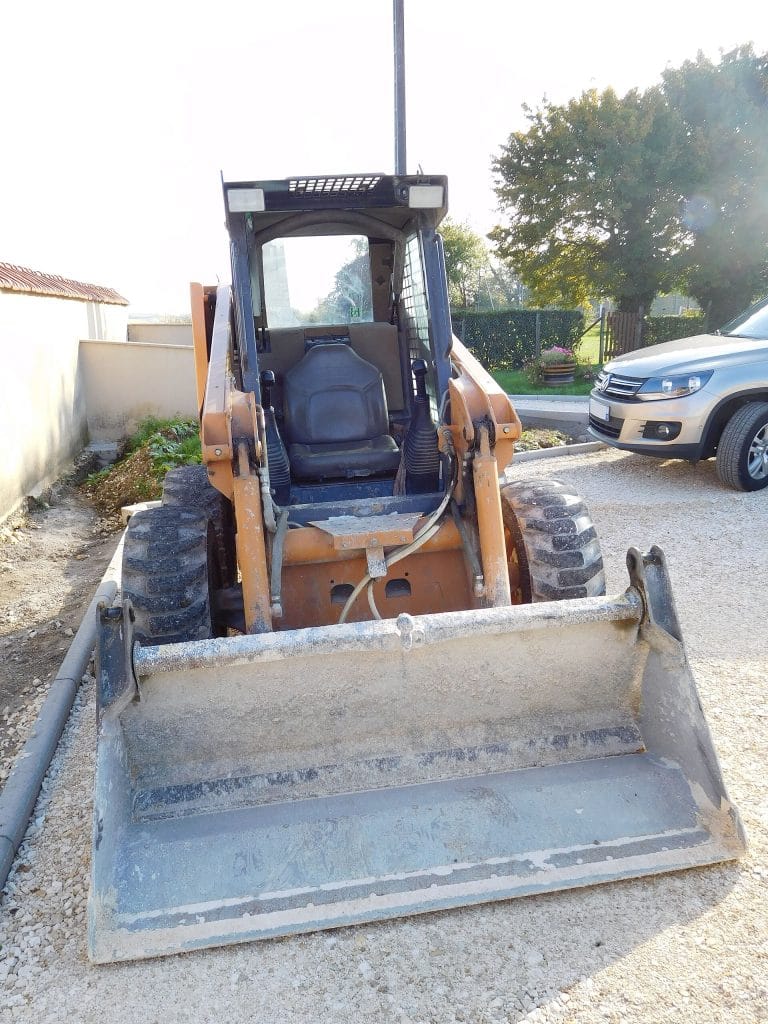
The quick-attach plate is what makes a skid-steer so useful. You can swap a bucket for pallet forks or a snow pusher in a minute or two. But that speed has a cost. If the plate isn’t fully locked, the attachment can come off. It can slide down the lift arms or drop onto someone standing nearby.
Here’s how it happens and a short routine that prevents it.
How a quick-attach works
Most skid-steers and compact track loaders use a similar design. The top edge of the coupler plate tucks under a lip on the back of the attachment. You curl the plate back to lift the attachment. Then two wedges or pins drive down through slots in the bottom of the attachment’s mounting plate. Those pins are what hold it on.
On a manual quick-attach, you push two levers down by hand. On a power quick-attach, you use a switch in the cab and hydraulics move the pins. Either way, the attachment is only secure when both pins are fully through both slots.
How attachments come off
Most attachment drops come down to the pins not being fully engaged. Common causes:
- Skipping the lock “just for a minute.” The operator hooks an attachment to move it a short distance and doesn’t lock it.
- One pin in, one pin out. A lever is only partway down, or a pin is blocked by mud, ice or gravel. From the seat, it can look fine.
- Trusting the switch. On a power quick-attach, pressing the button doesn’t prove the pins went through. Frozen or damaged pins can stop short.
- Worn or damaged parts. Bent levers, weak springs, worn wedges or a bent mounting plate can stop the pins from seating.
- The wrong attachment. An attachment that isn’t approved for your machine may not fit the coupler properly.
Why it matters
The Canadian Centre for Occupational Health and Safety (CCOHS) warns that an unlocked attachment “could break free and roll down the loader arms or fall onto a bystander.” Its guidance for loader operators is to always make sure the locking devices are in place, “even if you are switching attachments for only a few minutes.” It also says to use only manufacturer-approved attachments and buckets.
Attachments are heavy. A bucket or set of forks falling from a raised position can seriously injure or kill a person on the ground.
Lock, look, test: every time you change attachments
- Clean it. Knock mud, snow and ice off the coupler, the pins and the slots on the attachment. In winter, packed snow is an easy way for a pin to stop short.
- Hook and curl. Tuck the top of the coupler under the lip, then curl back until the attachment sits flat against the plate.
- Lock. Push both levers fully down, or use the switch on a power quick-attach. Follow the steps in your operator’s manual.
- Look. Check both sides. Both pins should be all the way through the slots and both levers fully down. If you can’t see the pins from the seat, lower the attachment, shut down safely and get out to check.
- Test. Test the connection the way your operator’s manual describes before you lift or carry anything. If anything moves or looks wrong, lower the attachment to the ground, unlock it and start again.
Keep people clear
- Keep other workers away while you hook up and test an attachment.
- Never let anyone stand or walk under a raised attachment.
- Travel with the attachment as close to the ground as possible, and don’t travel or turn with the lift arms up.
- Lower the bucket or attachment to the ground when you’re not using the loader.
Inspect the coupler before each shift
Add the quick-attach to your pre-shift walk-around. Check that:
- The levers move freely and spring back into place.
- Both pins extend fully and aren’t bent, cracked or badly worn.
- The coupler plate and the attachment’s mounting plate aren’t bent or cracked.
- On a power quick-attach, hoses and fittings aren’t leaking or damaged.
If you find damage, don’t use the machine. Report it and follow your employer’s procedures for taking equipment out of service. In Alberta, the rules for powered mobile equipment are in Part 19 of the OHS Code, which includes sections on inspection and the operator’s manual. Elsewhere, follow your employer’s procedures and the rules in your province.
Make it part of training
Changing attachments is a skill, not an afterthought. New operators should practise it with a supervisor watching, and the sign-off should cover it. Our post on skid-steer operator training in Alberta covers what employers need to have in place.
Our Skid-Steer Loader Safety course walks operators through safe skid-steer operation in short online lessons. You can try the first lesson free.