
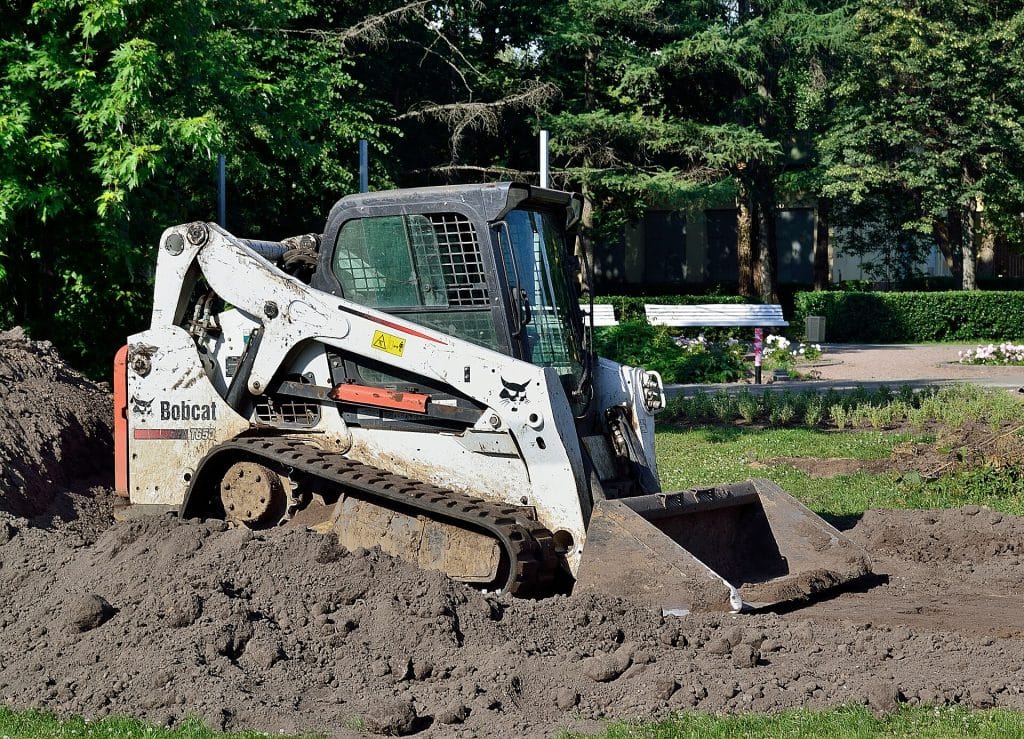
A wheeled skid-steer and a compact track loader (CTL) look almost the same from the seat. Same lift arms, same quick-attach, often the same controls. But they behave differently on the ground, and picking the wrong one can cost you time, money and stability. Here’s how to choose, and what changes for the operator.
This is general information, not legal advice.
The one real difference: tires or tracks
A skid-steer sits on four tires. A CTL sits on two rubber tracks. Everything else follows from that.
- Tires put the machine’s weight on four small contact patches. That means high ground pressure, good grip on firm surfaces and more speed.
- Tracks spread the same weight over a much bigger area. That means low ground pressure, so the machine floats on soft ground instead of sinking.
When a wheeled skid-steer makes sense
- Pavement, concrete and hard-packed gravel. Tires grip well here, and they usually wear better than rubber tracks on hard surfaces.
- Lots of travel. Skid-steers are generally faster than a CTL of similar size.
- Snow clearing on paved lots. Many contractors run wheeled machines for this, often with aggressive winter tires fitted for the season.
- Lower running costs. There’s no undercarriage of rollers, idlers and tracks to inspect, grease and eventually replace.
When a compact track loader makes sense
- Mud, sand, wet clay and soft ground. Low ground pressure keeps the machine on top and keeps it working after rain.
- Finished turf and landscaping. Tracks do less damage to lawns than tires, as long as you avoid sharp spin turns.
- Grading and rough, uneven sites. The long track footprint gives a smoother ride and steady pushing power.
- Deep or soft snow. Tracks pull well in it. On packed snow and ice over pavement, ask your dealer about a bar-style tread, since standard tracks can slide.
Lifting: the CTL gets a smaller safety margin
This one surprises people. Manufacturers rate compact loaders using ISO 14397-1. For wheeled machines, the rated operating capacity (ROC) is no more than 50% of the tipping load. For tracked machines, it’s no more than 35%.
So a CTL may have a higher tipping load than a skid-steer, but its working limit is set further below it. Don’t assume the bigger-looking machine can carry more. Read the ROC on the decal and in the operator’s manual for the exact machine you’re running. Our post on tipping load vs rated operating capacity walks through the math.
What changes for the operator
The basic hazards are the same on both machines: tip-overs, crush points at the lift arms, people in the blind spots and attachments that aren’t locked on. But a few habits differ.
- Daily checks. On a skid-steer, check tire pressure and condition. On a CTL, check track tension, look for cuts and missing lugs, and clear packed mud, rock or ice out of the undercarriage. Our 8-point walk-around covers both.
- Slopes. Keep both tracks fully on the ground. Avoid running with one track on a slope and the other on flat ground. See forward or reverse on a slope.
- Curbs and drop-offs. Tracks can tip over an edge and drop suddenly. Cross curbs slowly and squarely, with the bucket low.
- Turning. Spin turns on pavement wear tracks fast. Use wider, three-point style turns where you have room.
If your operators move between a skid-steer and a CTL, don’t treat them as the same machine. Train and evaluate each operator on each type they’ll use, with the attachments they’ll use.
Does the law treat them differently?
In Alberta, both are powered mobile equipment. Part 19 of the Alberta OHS Code covers things like operator responsibilities, the visual inspection before use, rollover protective structures and seat belts. Your duty to make sure operators are trained and competent is the same either way. In other provinces, follow your employer’s procedures and the rules in your province. For more, read skid-steer operator training in Alberta.
Quick decision guide
- Mostly hard surfaces, lots of travel, tight budget: wheeled skid-steer.
- Mostly soft ground, turf or grading: compact track loader.
- Mixed work: rent the other type for the jobs your machine handles poorly.
Train for the machine you run
Our Skid-Steer Loader Safety course covers both wheeled skid-steers and compact track loaders of any make, including stability, daily checks and slopes. Want a look first? Try the first lesson free.